
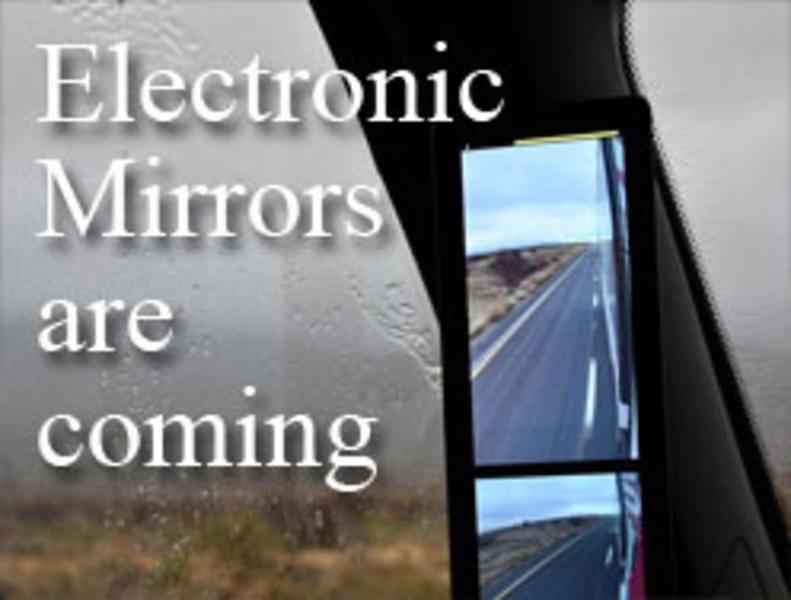
Trucking info magazine has a great article on how replacement of mirrors with cameras and monitors will be the next big change for people driving trucks.
Replacing traditional side mirrors with camera-and-monitor systems will be a far bigger adjustment for drivers than the shift to automated transmissions ever was. Giving up a gearshift was significant—but losing mirrors fundamentally changes how drivers interact with their environment. That’s a much bigger leap.
That reality became clear after my recent test drive of the MirrorEye system from Stoneridge. The response from readers—via comments, emails, and messages—was largely skeptical, if not outright resistant. I’ll admit, I once shared that skepticism. While my opinion softened over time as I learned more and watched the system in action, it was the test drive itself that erased most of my concerns. By the end, I found the technology not only usable, but genuinely workable.
After reading the feedback, though, it’s clear that some objections are rooted less in the system’s shortcomings and more in discomfort with change. Many criticisms leveled at camera-based systems could just as easily be applied to conventional glass mirrors.
Anything radically new invites pushback. Because camera/monitor systems represent such a significant departure—and affect drivers every moment of their workday—I went deeper than usual in my original review. I wanted to understand not only how the system works, but what happens when it doesn’t. What if a camera fails? What if the system crashes?
One reader put it bluntly: “What happens when this thing quits working on the Cross Bronx? Mirrors have worked forever. Another knock against drivers with millions of safe miles.”
It’s a fair concern. But mirrors fail too—and probably more often. In the early 1980s, I routinely lost mirrors crossing what we called “The Skinny Bridge” over the Susquehanna River in Pennsylvania. It was so narrow that the centerline was littered with broken mirror glass. Few things snap you to attention faster—especially in a cabover—than a mirror exploding inches from your face.
Losing the right-hand mirror was even worse, particularly if the convex mirror went with it. With MirrorEye, redundancy is built in. Each camera wing houses two cameras—standard and wide-angle—and each monitor displays both views. Stephen Fox, vice president of business development, explained that if one camera or monitor fails, the others continue operating.
There are also fail-safes. If the system goes down entirely, the screen turns blue rather than freezing or going black, alerting the driver immediately. Unless the camera wing is physically destroyed or the entire system loses power, drivers are unlikely to be left without some form of rearward visibility—much like traditional mirrors.
Yes, replacing a broken camera or monitor would cost more than swapping out a $20 mirror from decades past. But today’s aerodynamic mirror assemblies aren’t cheap either.
Concerns about distraction—particularly from the left-hand monitor—also surfaced frequently. Initially, I noticed it. It was new, different, and drew my attention. But after about an hour behind the wheel, it faded into the background. The habit of glancing outside to where a mirror used to be lingered briefly, but muscle memory adjusted quickly.
Another common worry was lens contamination from rain, snow, or grime. I drove in clear weather, but Stoneridge has footage showing the camera lens remaining clear in heavy rain while the side window is streaked with water. The lens is hydrophobic, meaning it repels moisture—much like heated mirrors, which, frankly, don’t always work as advertised.
When regulators eventually formalize standards for these systems, I expect lens cleanliness and visibility to be central requirements. Unlike mirrors, monitors sit inside the cab, protected from the elements.
Safety Implications
Camera-based systems aren’t magically safer than mirrors, but they do offer tangible advantages. The combined standard and wide-angle views provide a broader field of vision, and MirrorEye’s trailer-tracking feature follows the trailer wheels through turns—particularly useful during right-hand turns, traditionally a blind-spot nightmare.
Fox also noted that many forward-facing camera functions—lane departure alerts, object detection, event recording—could eventually be integrated into rearward camera systems. The test truck didn’t include those features, but the potential is clearly there.
Monitor placement raised additional questions, especially for drivers of smaller stature. While current systems allow some adjustment, it’s easy to imagine OEMs eventually integrating monitors directly into A-pillars or dashboards. That might limit customization, but it wouldn’t be much different from today’s standardized mirror layouts—and it would eliminate blind spots created by external mirrors.
One reader suggested an excellent idea: overlaying backing guidelines on the monitor display, similar to passenger vehicle backup cameras. Given existing steering sensors and stability systems, generating a projected trailer path seems entirely feasible—and could significantly improve low-speed maneuvering.
Stoneridge also offers a third, optional “look-down” monitor that replaces the convex mirror view along the passenger side. While most drivers prefer it mounted at the top-center of the windshield, I found that placement counterintuitive. Mounting it above the passenger door or integrating it into the headliner would better align with natural sightlines.
The Regulator’s Challenge
OEMs, regulators, and technology developers all have reasons to push mirror replacement—from fuel efficiency gains to expanded safety capabilities. Drivers, understandably, are less enthusiastic about losing something familiar.
Fox says drivers currently using MirrorEye love it. After my experience, I can see why. The system functions remarkably like a traditional mirror—and improves on it in key areas.
But MirrorEye won’t be the only solution. Many of its strengths may be patented, forcing competitors to innovate differently. Some alternatives already exist overseas, such as Mekra-Lang’s Vision 4.0 system used on European trucks.
Regulators will need to establish careful, consistent standards—covering image quality, brightness, night performance, placement, and reliability—while ensuring familiarity across brands. MirrorEye already had to meet existing mirror standards to earn a federal exemption, but future systems may require additional guidelines.
Driver acceptance should be paramount. These systems will likely remain optional for some time, but pressure will mount to make them standard—or even mandatory. Early on, some drivers will undoubtedly blame crashes on unfamiliar visuals. There is a difference between what you see on a screen and what you expect from a mirror.
Younger and less experienced drivers will likely adapt first. Veteran drivers may resist—until they spend an hour or two using the system. At that point, many will change their minds. What remains less certain is the return on investment. The safety and efficiency gains are promising—but proving their value will be the final hurdle.